Author: Lauren from EDDA

  • Edda jetzt auf Deutsch: Investmentmanagement in Ihrer Sprache

    Edda jetzt auf Deutsch: Investmentmanagement in Ihrer Sprache

    Die beste Investmentsoftware passt sich an Ihr Team an – nicht umgekehrt. Bei Edda verfolgen wir das Ziel, Investitionen einfacher und intuitiver zu machen, indem wir unsere Plattform an die Arbeitsweisen von Investmentteams anpassen. Dazu gehört auch, dass Teams ihre Investmentprozesse in der Sprache verwalten können, die sie im Arbeitsalltag bevorzugen.

    Edda ist jetzt auf Deutsch verfügbar. Damit können deutschsprachige Investmentteams Dealflow, Portfolios, CRM, Dokumente und Investmentdaten in einer vertrauten Benutzeroberfläche verwalten und gleichzeitig mit internationalen Kollegen auf derselben Plattform zusammenarbeiten.

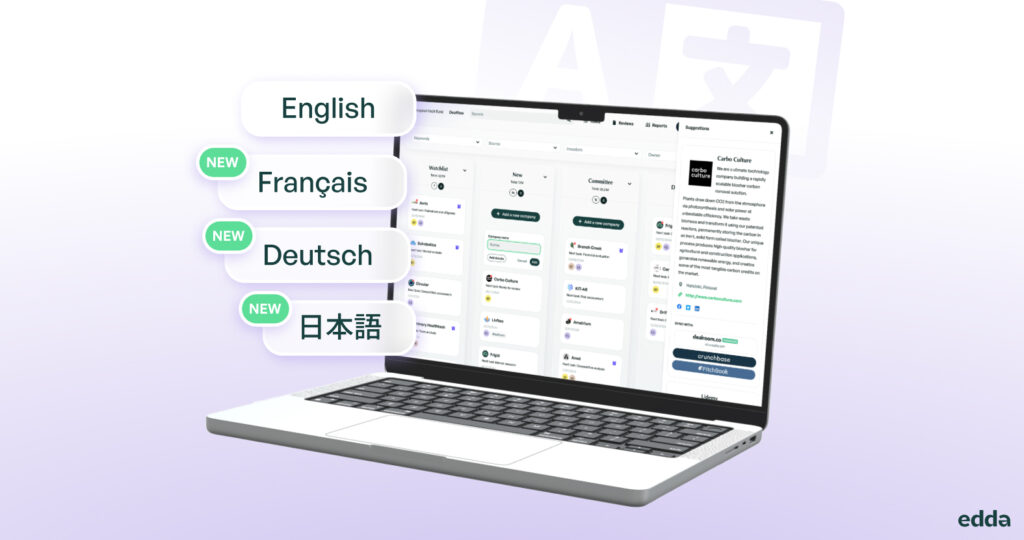
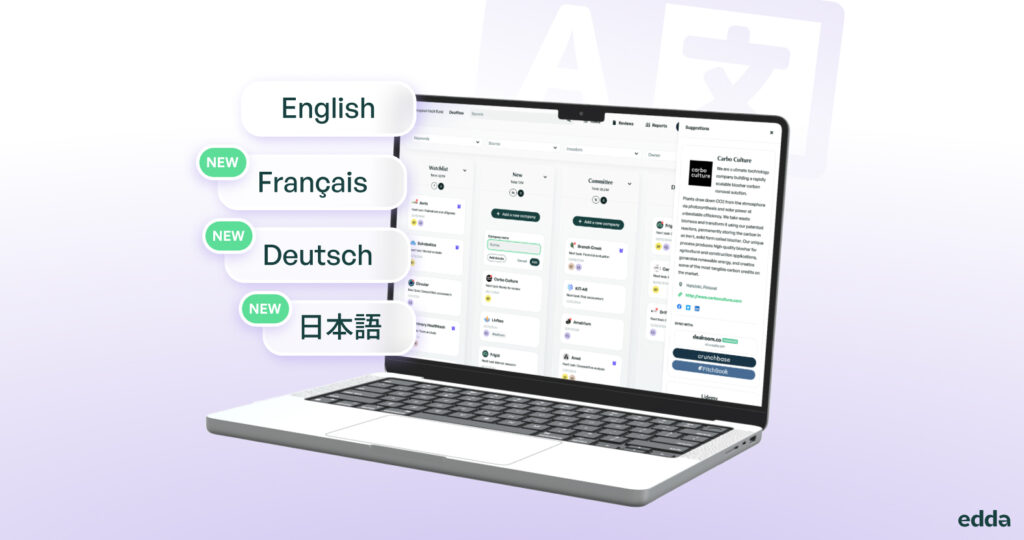
    Neben Deutsch ist Edda auch auf Englisch, Französisch und Japanisch verfügbar.

    Eine Investmentplattform für das gesamte Team

    Investmentteams arbeiten täglich mit Informationen aus E-Mails, Tabellen, Dokumenten und verschiedenen Softwarelösungen. Wenn diese Informationen auf mehrere Systeme verteilt sind, wird es schwieriger, den vollständigen Kontext eines Investments zu erhalten und alle Teammitglieder auf dem gleichen Stand zu halten.

    Edda verbindet die wichtigsten Investmentprozesse in einer zentralen Plattform:

    • Dealflow: Investmentmöglichkeiten verfolgen und Unternehmen über den gesamten Investmentprozess verwalten.
    • Portfolio Management: Informationen zu Portfoliounternehmen und deren Aktivitäten zentral verwalten.
    • CRM: Kontakte und Beziehungen zu Gründern, Investoren und Portfoliounternehmen organisieren.
    • Dokumente: Wichtige Investmentinformationen strukturiert mit Unternehmen und Deals verknüpfen.
    • LP Relations: LPs eine übersichtliche Oberfläche für Updates, Reports und Kennzahlen bereitstellen.

    So arbeitet das gesamte Team mit denselben Informationen, anstatt Daten in verschiedenen Systemen zu verwalten.

    Investmentmanagement auf Deutsch

    Die Sprache einer Software beeinflusst, wie intuitiv sie sich in den Arbeitsalltag integrieren lässt. Eine deutschsprachige Benutzeroberfläche ermöglicht es Investmentprofis, Edda in der Sprache zu nutzen, die sie täglich verwenden – und erleichtert gleichzeitig die Einführung der Plattform im gesamten Team.

    Besonders für deutschsprachige VC-, PE- und CVC-Teams bietet die deutsche Version die Möglichkeit, bestehende Investmentprozesse in einer vertrauten Umgebung abzubilden, ohne auf eine gemeinsame Plattform mit internationalen Kollegen verzichten zu müssen.

    Den vollständigen Investmentkontext zentralisieren

    Investmententscheidungen basieren selten auf einer einzigen Information. Unternehmensdaten, Gespräche, Kontakte, Dokumente, Pipeline-Historie und Portfolioaktivitäten bilden gemeinsam den Kontext eines Investments.

    Edda verbindet diese Informationen rund um die jeweiligen Unternehmen und Investments. Dadurch können Teams schneller nachvollziehen, was bereits passiert ist, welche Informationen verfügbar sind und welche nächsten Schritte relevant sind.

    Statt Informationen aus individuellen Postfächern, Tabellen und Dateisystemen zusammenzusuchen, steht der relevante Investmentkontext zentral zur Verfügung.

    Weniger manuelle Dateneingabe

    Investmentteams verbringen viel Zeit mit der Pflege ihrer Daten: Unternehmensinformationen aktualisieren, Kontakte hinzufügen, Pipeline-Phasen ändern und Dokumente organisieren.

    Edda verbindet diese Workflows und nutzt Integrationen und Automatisierungen, um die Erfassung und Organisation von Informationen zu vereinfachen.

    Weniger Zeit für Datenpflege, mehr Zeit für Investments.

    Für internationale Investmentteams

    Die deutsche Sprachversion ist Teil von Eddas Bestreben, Investmentmanagement für Teams weltweit einfacher und intuitiver zu machen.

    Edda ist jetzt auf Deutsch, Englisch, Französisch und Japanisch verfügbar. Internationale Teams können damit auf einer gemeinsamen Plattform arbeiten und gleichzeitig die Sprache wählen, die am besten zu ihrem jeweiligen Arbeitsprozess passt.

    Entdecken Sie Edda auf Deutsch und erfahren Sie, wie die Plattform Ihren Investmentprozess unterstützen kann. Vereinbaren Sie eine Demo mit dem Edda-Team.

  • Eddaが日本語に対応:日本語で利用できる投資管理プラットフォーム

    Eddaが日本語に対応:日本語で利用できる投資管理プラットフォーム

    優れた投資管理ソフトウェアは、チームに合わせて使えるものであるべきです。Eddaは、投資業務をより簡単かつ直感的にすることを目指し、Dealflowやポートフォリオ管理から投資データの整理、チーム間のコラボレーションまで、実際の投資チームの業務プロセスに合わせてプラットフォームを進化させています。

    その一環として、Eddaが日本語に対応しました。 日本のVC、PE、CVCなどの投資チームは、Dealflow、Portfolio、CRM、ドキュメント、投資データを日本語で管理しながら、海外のチームメンバーとも同じプラットフォーム上で連携できます。

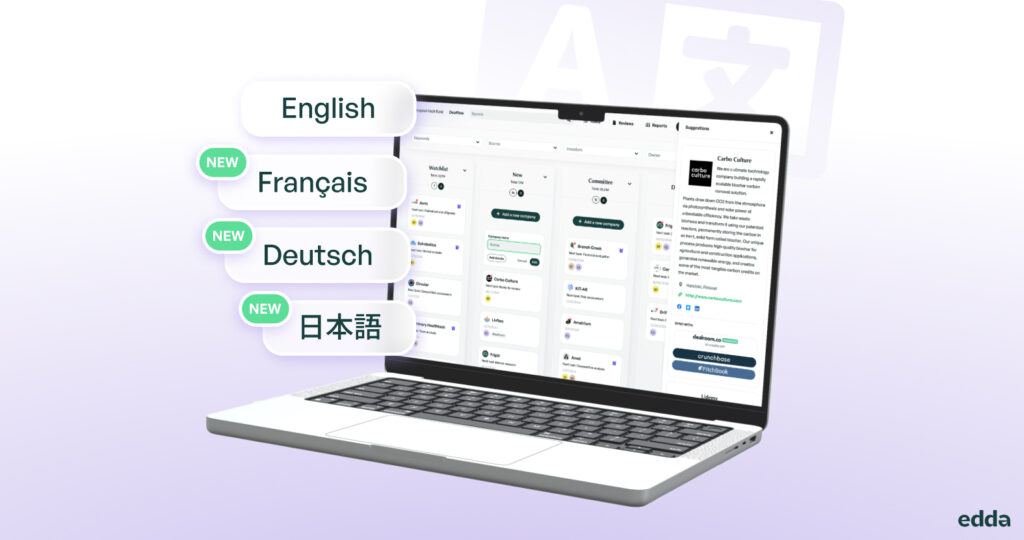
    Eddaは日本語に加えて、英語、ドイツ語、フランス語でも利用できます。

    チーム全体をつなぐ一つの投資管理プラットフォーム

    投資チームは、メール、スプレッドシート、ドキュメント、複数のソフトウェアなど、さまざまな場所にある情報を日々扱っています。

    情報が分散すると、投資全体のコンテキストを把握することが難しくなり、同じ情報を複数のシステムに入力するなど、手作業も増えていきます。

    Eddaでは、主要な投資ワークフローを一つのプラットフォームで管理できます。

    • Dealflow: 投資機会を追跡し、投資プロセス全体を通じて企業を管理。
    • Portfolio Management: ポートフォリオ企業の情報や活動を一元管理。
    • CRM: 起業家、投資家、ポートフォリオ企業などとの関係性を管理。
    • Documents: 投資に関する重要なドキュメントを企業や案件と紐付けて整理。
    • LP Relations: LP向けにアップデート、レポート、指標を提供。

    これにより、チーム全体が同じデータと情報を共有しながら、投資プロセスを管理できます。

    日本語で利用できる投資管理プラットフォーム

    ソフトウェアの言語は、日々の業務プロセスの一部です。普段使っている言語で投資管理プラットフォームを利用できれば、操作をより直感的に行うことができ、チーム内での導入・定着もスムーズになります。

    Eddaの日本語対応により、日本語を主に使用する投資プロフェッショナルは、より自然な環境で日々の投資業務を行えるようになりました。

    また、海外チームとは同じプラットフォーム、同じデータ、同じ投資コンテキストを共有できます。チームごとに別々のシステムを導入する必要はありません。

    投資に関するすべてのコンテキストを一つの場所に

    投資判断には、企業情報だけでなく、これまでのコミュニケーション、コンタクト、ドキュメント、パイプラインの履歴、ポートフォリオでの活動など、さまざまな情報が関係します。

    Eddaはこれらの情報を関連する企業や投資案件と紐付け、投資に関するコンテキストを一元化します。

    メールボックスやスプレッドシート、複数のファイルシステムを個別に検索するのではなく、必要な情報を一つのプラットフォームから確認できます。

    これにより、チーム内での情報共有を促進し、組織としての投資に関する知識を蓄積しやすくなります。

    手作業によるデータ入力を削減

    投資チームでは、企業情報の登録や更新、コンタクトの追加、パイプラインのステージ変更、ドキュメントの整理など、多くのデータ管理作業が発生します。

    Eddaは投資ワークフローをつなぎ、インテグレーションや自動化を活用することで、情報の収集・整理にかかる手作業を減らします。

    システムの管理に費やす時間を減らし、投資そのものにより多くの時間を使う。 それがEddaの目指すところです。

    国際的な投資チームのために

    日本語対応は、世界中の投資チームにとって投資管理をより簡単で直感的なものにするというEddaの取り組みの一環です。

    Eddaは現在、日本語、英語、ドイツ語、フランス語に対応しています。国際的なチームは同じプラットフォームとデータを共有しながら、それぞれのメンバーが自分の業務プロセスに最も適した言語で利用できます。

    Eddaを日本語で体験し、投資業務をどのようにサポートできるかをご覧ください。Eddaチームにデモをご依頼ください。

  • Edda est désormais disponible en français : gérez vos investissements dans votre langue

    Edda est désormais disponible en français : gérez vos investissements dans votre langue

    Les meilleurs logiciels d’investissement s’adaptent à votre équipe, et non l’inverse. Chez Edda, notre mission est de rendre l’investissement plus simple et plus intuitif en adaptant notre plateforme aux méthodes de travail des équipes d’investissement. Cela passe notamment par la possibilité de travailler dans la langue qui correspond le mieux aux habitudes de chaque équipe.

    Edda est désormais disponible en français. Les équipes francophones peuvent ainsi gérer leur dealflow, leur portefeuille, leur CRM, leurs documents et leurs données d’investissement dans une interface familière, tout en collaborant avec leurs collègues internationaux sur la même plateforme.

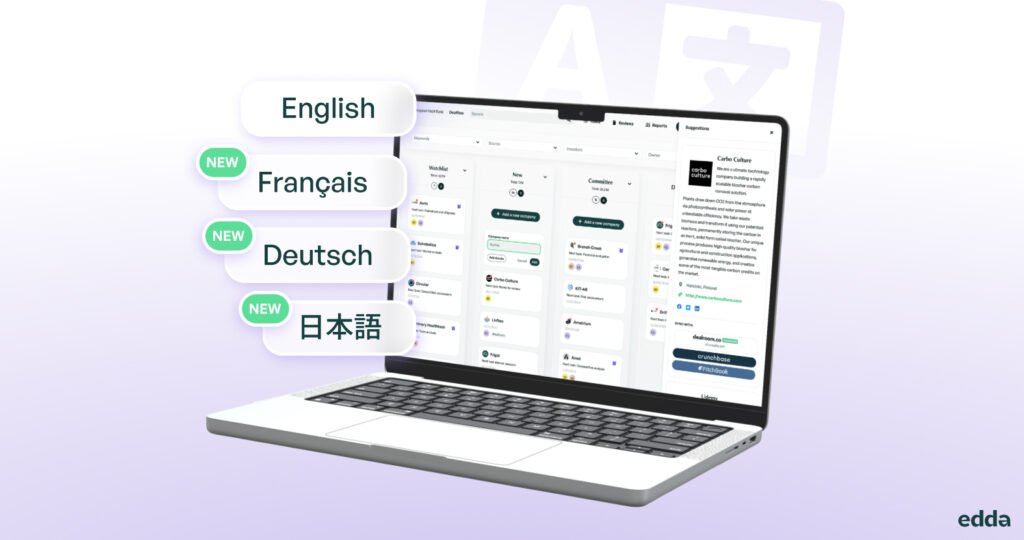
    Edda est également disponible en anglais, allemand et japonais.

    Une plateforme d’investissement pour toute l’équipe

    Les équipes d’investissement travaillent avec des informations provenant d’e-mails, de tableurs, de documents et de différents logiciels. Lorsque ces informations sont dispersées, il devient plus difficile de conserver une vision complète d’un investissement et de maintenir toute l’équipe alignée.

    Edda rassemble les principaux workflows d’investissement sur une même plateforme :

    • Dealflow : suivre les opportunités et gérer les sociétés tout au long du processus d’investissement.
    • Portfolio Management : centraliser les informations relatives aux sociétés du portefeuille et à leurs activités.
    • CRM : gérer les contacts et les relations avec les fondateurs, investisseurs et sociétés du portefeuille.
    • Documents : organiser les informations importantes et les associer aux sociétés et aux deals concernés.
    • LP Relations : offrir aux LPs une interface claire pour recevoir des mises à jour, rapports et indicateurs.

    Les équipes peuvent ainsi travailler à partir des mêmes données, sans multiplier les systèmes ou les saisies.

    Le logiciel d’investissement dans votre langue

    La langue d’un logiciel fait partie du processus de travail. Une interface en français permet aux professionnels francophones de naviguer dans leur plateforme d’investissement de manière plus naturelle et facilite son adoption par l’ensemble de l’équipe.

    Pour les équipes françaises et francophones, Edda permet ainsi de gérer leurs processus d’investissement dans un environnement familier, tout en restant connectées à leurs collègues internationaux.

    Conserver tout le contexte d’un investissement

    Une décision d’investissement ne repose jamais sur une seule donnée. Informations sur les sociétés, conversations, contacts, documents, historique du pipeline et activités du portefeuille contribuent tous au contexte global d’un investissement.

    Edda relie ces informations aux sociétés et investissements concernés, offrant aux équipes une vision plus complète de leur activité.

    Plutôt que de rechercher des informations dans différentes boîtes mail, des tableurs ou des systèmes de fichiers, les professionnels peuvent accéder au contexte dont ils ont besoin depuis une plateforme centralisée.

    Réduire la saisie manuelle

    La mise à jour des données représente une part importante du travail administratif des équipes d’investissement : ajouter des sociétés, mettre à jour les contacts, modifier les étapes du pipeline ou organiser les documents.

    Edda connecte ces différents workflows et utilise des intégrations et des automatisations pour faciliter la collecte et l’organisation des informations.

    Moins de temps consacré à la gestion des données, plus de temps consacré à l’investissement.

    Une plateforme pour les équipes internationales

    La version française s’inscrit dans la volonté d’Edda de rendre la gestion des investissements plus simple et plus intuitive pour les équipes du monde entier.

    Edda est désormais disponible en français, anglais, allemand et japonais. Les équipes internationales peuvent ainsi partager la même plateforme et les mêmes données, tout en permettant à chaque membre de travailler dans la langue qui correspond le mieux à son processus.

    Découvrez Edda en français et voyez comment la plateforme peut s’intégrer à votre processus d’investissement. Réservez une démonstration avec l’équipe Edda.

  • Edda is Now Available in German, French, and Japanese

    Edda is Now Available in German, French, and Japanese

    The best investment software adapts to your team, not the other way around. At Edda, our mission is to make investing easier and more intuitive, from managing deal flow and portfolio companies to organizing investment data and collaborating across teams. That also means making Edda accessible in different languages for different users.

    Edda is now available in German, French, and Japanese, giving investment teams more flexibility to use the platform in the language that fits their existing processes. Whether your team operates in one market or across multiple countries, Edda helps everyone work from the same platform, with the same investment data and context.

    Looking for a truly intuitive private capital software in your language? Book a demo to see how Edda can transform your investments.

    One Investment Platform for the Entire Team

    Investment teams work with information across emails, spreadsheets, documents, and multiple software tools. When these workflows become fragmented, it becomes harder to maintain a complete view of an investment and keep everyone aligned.

    Edda brings these workflows together in one investment management platform, connecting Dealflow, Portfolio, CRM, documents, contacts, and LP relations.

    Teams can manage:

    • Dealflow: Track opportunities and manage companies throughout the investment process.
    • Portfolio management: Maintain comprehensive records of portfolio companies and their ongoing activity.
    • CRM: Centralize contacts and relationships across founders, investors, and portfolio companies.
    • Documents: Cleanly store important investment information connected to the companies and deals.
    • LP Relations: Provide your LPs with a clean interface to receive updates, reports, and metrics.

    By connecting these workflows, Edda helps teams spend less time searching for information or maintaining disconnected systems and more time on the investment process itself.

    Work in the language that fits your process

    The language of your software is part of your workflow. When teams can navigate their investment platform in the language they use every day, it can make processes more intuitive and easier to adopt across the organization.

    With Edda now available in German, French, and Japanese, investment professionals can work in their preferred language while remaining connected to colleagues working in other languages.

    For international investment firms, this means teams can share the same platform, data, and investment context without requiring every member of the organization to work in the same language.

    Keep the full investment context in one place

    Investment decisions rarely depend on a single data point. Company information, conversations, contacts, documents, pipeline history, and portfolio activity all contribute to the broader context of an investment.

    Edda connects this information around the companies and investments it relates to, giving teams a more complete view of their work.

    Rather than searching through individual inboxes, spreadsheets, and file systems, investment professionals can access the information they need from a centralized platform. This makes it easier to collaborate, maintain institutional knowledge, and understand the history behind an investment.

    Reduce manual data entry

    Investment teams also spend significant time maintaining their data. Company records need to be updated, contacts added, pipeline stages changed, and documents organized.

    Edda is designed to reduce this administrative work by connecting investment workflows and using integrations and automation to help capture and organize information.

    The goal is simple: less time spent managing the system, and more time spent investing.

    Investment management that adapts to your team

    Adding German, French, and Japanese to Edda is part of a broader effort to make investment management more intuitive for teams around the world.

    Whether you’re managing a local fund or working across international offices, Edda provides a shared environment for managing deal flow, portfolios, relationships, and investment information—while giving each team member the flexibility to work in the language that best supports their process.

    Discover Edda to see how it can support your investment workflow. Book a demo with the Edda team.

  • Client Spotlight: How VC IgniteXL eliminated manual deal management with Edda

    Client Spotlight: How VC IgniteXL eliminated manual deal management with Edda

    IgniteXL, a seed-stage fund investing in tech-driven wellness companies, is on a mission to back startups reshaping how we live, look, and age. 

    As their fund and team grew, IgniteXL realized that their outdated systems were burdening and blocking them from their full potential.

    We spoke to Luke Deasy, Associate at IgniteXL, who detailed how Edda helped IgniteXL improve workflows across deal management, reporting, collaboration, and customization to unlock a high-level investment strategy.

    Managing deals with flexibility, not friction

    Early-stage investing means navigating an unpredictable and wide-ranging pipeline. For IgniteXL, the rigidity of their previous platform before Edda made this process impossible to support their dynamic workflow.

    “What appealed to me most personally is the pliability of the platform… Edda allows for virtually infinite flexibility in terms of how you want to organize your pipeline.” 

    – Luke Deasy, IgniteXL

    Where their previous system locked them into a fixed funnel, Edda allowed Luke to completely restructure pipeline stages, including nuanced statuses like “intro call,” “awaiting GP feedback,” or “on hold for future.”

    This flexibility has made it possible for Luke’s team to collaborate in real time and personalize their workflows. Luke specified that it has created better clarity on where deals stand and who is responsible for the next step, all without manual workarounds that they experienced previously.

    Automated reporting for LPs

    When it comes to VC reporting, many firms are still stuck with archaic workflows dependent on Excel. IgniteXL was no exception, until Edda.

    “We’re just scratching the surface, but it’s night and day from our previous reporting… What used to take hours, if not days, of exporting and manual analysis, now takes seconds.” 

    Edda’s integrated reporting tools have helped IgniteXL offer better visibility to their LPs and reach better strategies. Thanks to the automated reporting function, Luke was able to generate reports for IgniteXL’s quarterly LP review.

    “This year we implemented quarterly venture partner reviews and as part of that we wanted to add pipeline reporting. In the past without Edda it would have been a huge headache and probably I would have just said let’s not do this, but I was able to use Edda to get the reports and use those for our presentation.

    That was the first moment where we were able to collaboratively discuss the health of the portfolio and pipeline and figure out how we should orient our efforts and figure out deal attribution.”

    Customization built for VC workflows

    Every fund has its own internal structure: how it categorizes deals, tracks interactions, stores notes, and defines success. But when platforms aren’t investment-focused or updated with the evolution of the industry, VCs are forced to adopt work-arounds.

    “In the past, I had to make a Word doc listing every field and send it to the platform so they could manually implement it. Now I can just do it myself in Edda.”

    From customizing data fields on company pages to restructuring what information is shown to GPs at a glance, Edda gives IgniteXL the freedom to create the environment that suits their firm.

    Scaling operations with Edda 

    As IgniteXL scales its operations, from a $10M first fund to a $30M second fund, operational efficiency has only grown in importance. 

    “I tried to automate [our previous workflow] as much as I could, but it was still pretty brutal. I would say [Edda] has probably saved me 75% of my time on deals.”

    By transitioning to Edda, IgniteXL has achieved a manual work offload, strong foundation for investment decisions, and reporting clarity.

    For other funds struggling with similar issues such as manual task burdens, disjointed collaboration, or onboarding LPs, Edda offers the platform to support ambitions to scale.


    About IgniteXL 

    IgniteXL is a seed-stage fund investing in tech-driven wellness companies that help people live, look, and age better. They focus on diverse, underrepresented founders building products at the intersection of technology and consumer impact.


    Want to learn how Edda can modernize your VC workflows? → Learn more and request a demo.

  • AI Experts Speak at The Symposium: AI Edition, Hosted by Edda and UTokyo

    AI Experts Speak at The Symposium: AI Edition, Hosted by Edda and UTokyo

    How is AI shaping the future across industries? This is the question keynote speakers of The Symposium: AI Edition explored during Edda and UTokyo’s 2024 event on artificial intelligence and innovation.

    The Symposium: AI Edition invited 150 influential figures in finance, venture capital, and technology to the National Library of France – Richelieu to explore AI’s transformative impact across sectors including finance, health, defense, innovation, and architecture.

    Keep reading to discover insights from The Symposium: AI Edition’s expert speakers on the future of AI in startups, private markets, and VC investing.

    AI in VC: The AI Funding Trend

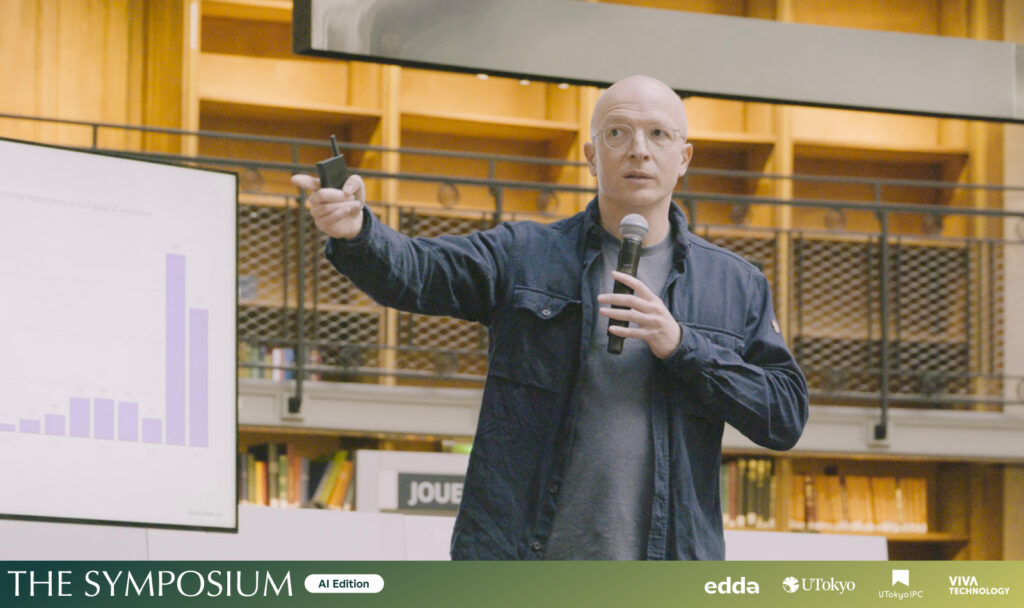
    The Symposium: AI Edition opened with a presentation from Dealroom.co CEO and Founder Yoram Wijngaarde, who shared exclusive data on the current state of AI investing.

    New Heights for VC Funding in AI

    Wijngaarde highlighted the unprecedented growth in AI-related venture capital funding. As of May 2024, 20% of all VC capital now flows into AI-first companies—a record share. While early-stage funding ($0–15M) remains active, it’s the breakout and late-stage rounds—especially for foundational model companies—that are drawing billions.

    This funding boom in generative AI startups follows two earlier investment waves: one focused on autonomous driving, and another on AI in healthcare, both peaking around 2021.

    Funding by Layer

    Wijngaarde described a maturing AI ecosystem, where investment is now spread across foundational model development, infrastructure, and consumer-facing applications.

    Globally, more than 1,000 startups are building in the application layer, offering AI-powered products and tools. However, foundational model companies attracted the largest share—$23.8B compared to $7B in the application space—highlighting where technology investors see the greatest potential.

    The Consequences of AI’s Growing Popularity

    With AI’s rapid adoption comes a surge in energy demands. Combined with data centers and crypto, AI is projected to consume 1,000 TWh by 2026—the equivalent of Japan’s total electricity use. In the U.S., AI could represent 19% of electricity demand by 2030, accelerating parallel innovation in clean technology, including fusion, geothermal, and sustainable infrastructure.

    AI in Defense: A New Era of Arms

    Keynote speaker Antoine Bordes, VP of AI at Helsing, shared insights on AI’s rapidly expanding role in global defense technology.

    Bordes explained how AI innovation is drastically reducing the development time of advanced military systems—from years or decades to mere weeks. “Analyzing 24 hours of surveillance footage can take humans days—but AI can do it in seconds,” he noted.

    He also emphasized how recent global conflicts have accelerated the deployment of AI in defense, and how these technologies are being developed to support democratic resilience in a volatile geopolitical climate.

    AI in Health: Transforming the Value Chain

    Symposium speaker Alban de la Sabliere is an experienced finance and corporate development leader, now serving as COO at biotech unicorn Owkin. His M&A and partnership expertise from Sanofi and Morgan Stanley has helped scale Owkin’s AI‑driven healthcare platform.

    De la Sabliere offered a snapshot of how AI is set to revolutionize healthtech in 2025 and beyond. He outlined that AI is a “game changer” in unlocking the complexity of human biology, empowering scientists, and managing clinical data. These capabilities allow AI to accelerate every step in the biotech and pharmaceutical value chain, with a potential 40%+ reduction in R&D time.

    AI plays a transformative role across drug design, target discovery, development, and real-world use—strengthening the investment case for AI-focused healthcare startups.

    AI in Architecture: Supporting Creativity

    Renowned architecture firm Kengo Kuma & Associates joined The Symposium to deliver a unique panel. Executive VP Yuki Ikeguchi and Project Manager Asger Taarnberg explored how AI is transforming the architectural design process through data, simulation technology, and smarter planning tools.

    Taarnberg explained how AI turns traditional design elements like columns and windows into data-rich components, enabling more efficient modeling and sustainability. “AI helps us simulate design scenarios and understand local regulations, speeding up planning without sacrificing quality,” he said.

    While both speakers stressed that AI cannot replace human creativity, they highlighted its power as a design tool—especially for complex, international projects where technology innovation accelerates outcomes.

    The Symposium’s Lasting Impact

    Edda and the University of Tokyo created The Symposium: AI Edition to bring together leading experts in artificial intelligence, startups, and VC investing. By hosting an event at the frontier of AI’s expanding role in the global economy, the event aimed to connect AI builders with those financing the next wave of innovation.

    For Edda, this collaboration reflects its mission to empower venture capital and private equity firms with tools that drive smarter, faster, and more informed investment decisions.

    Edda’s specialized AI tools, HERA.I, streamline workflows, enhances portfolio intelligence, and strengthens client relationships—helping you stay ahead in finance 2025.

    To take your private investments to the next level, explore Edda’s leading deal management software for private equity and venture capital.

  • VC Due Diligence for Investors Investing in Startups

    VC Due Diligence for Investors Investing in Startups

    When startups seek funding, due diligence is the critical step where dreams meet scrutiny. More than a routine checkpoint, it’s where potential investments are thoroughly vetted for viability, risk, and opportunity

    For founders, due diligence is their moment to clearly articulate their business vision, demonstrate the strength of their operations, and prove their market potential. For investors, it’s the time to dig deep, going beyond the surface to examine a potential portfolio company’s financials, legal issues, and strategic positioning.

    Both parties stand to gain from well-conducted due diligence—founders can secure the capital and strategic support they need, while investors can confirm they’re placing their bets wisely. The effectiveness of this process can mean the difference between securing investment or going back to the drawing board. 

    In this guide, we’ll explore the essentials of due diligence and provide a VC diligence checklist to ensure that investors approach this phase with confidence and clear expectations. Feeling overwhelmed by the due diligence process? Discover how Edda’s venture capital management software can help. 

    What is Due Diligence in Venture Capital?

    Due diligence is a deep dive into a startup’s business, where investors verify everything from financials to business plans to uncover potential risks before committing to an investment. Think of it as a comprehensive health check for businesses, where no stone is left unturned. 

    For early-stage startups, due diligence is focused more on the team and the market potential. Since extensive financial data or customer metrics might not be available yet, investors look at the founders’ backgrounds, the innovativeness of the idea, and whether there’s a market demand for the proposed solution.

    For later-stage startups, the due diligence process becomes more granular. Investors scrutinize audited financial statements, customer acquisition costs, lifetime value of customers, and other metrics that show the business’s performance over time. Leadership’s ability to execute the business plan and scale the company also comes under the microscope.

    Venture Capital Due Diligence Checklist

    Due diligence is your shield as an investor, helping you deeply explore both the risks and opportunities of any potential investment. Here’s a comprehensive checklist to steer you through the critical evaluation points:

    Financial Due Diligence

    Financial due diligence is a deep dive into a company’s financial records to uncover risks and confirm its stability before investing. It will help you ensure documentation accuracy and identify any potential red flags. 

    1. Examine Historical Financials

    Thoroughly examine the startup’s past financial statements—income statements, balance sheets, and cash flows—to understand its financial health, operational efficiency, and growth potential. 

    Focus on assessing revenue growth, profit margins, asset management, and cash flow patterns to gauge profitability and stability. Analyzing historical data helps identify trends and informs decisions about the startup’s financial viability and prospects for expansion.

    🔺Red Flag:  Inconsistent Financials

    Discrepancies or irregularities in financial statements are major red flags. These can indicate poor management practices or even fraudulent activity. Be wary of mismatched figures, unexplained variances, or inconsistent reporting methods. These issues could compromise the accuracy of financial health assessments and impact investment decisions.

    The Theranos scandal is a stark warning about the dangers of neglecting thorough financial due diligence. Attracted by claims of revolutionary technology, investors poured money into Theranos, only to see the company crumble due to undisclosed financial irregularities and outright deceptions. 

    2. Analyze Financial Projections

    When analyzing financial forecasts, scrutinize assumptions about revenue growth, expenses, and market conditions for realism. Always validate market research methodologies and data sources to ensure accuracy. Conduct scenario analysis to test forecasts’ sensitivity to variable changes for resilience against market fluctuations.

    🔺Red Flag: Unrealistic Projections

    Overly optimistic financial forecasts that lack credible assumptions or supporting evidence can signal that the startup may not fully understand the market dynamics or their own operational capabilities. This can lead to future financial instability and missed targets. Watch for exaggerated growth rates, underestimations of expenses, and overly favorable market conditions in the projections.

    WeWork’s dramatic downfall shows the perils of accepting overly optimistic financial projections. Once valued at $47 billion, the company’s aggressive growth forecasts overlooked real market limits and operational costs, leading to a disastrous IPO withdrawal and a drastic valuation plummet.

    3. Assess Cash Flow Management

    Evaluate how the startup manages its cash flow by examining their burn rate and financial runway. Project future cash flows based on current spending patterns and anticipated revenue to anticipate any potential cash flow gaps. Assess how effectively the startup manages working capital, including receivables, payables, and inventory turnover, to maintain liquidity and operational stability.

    🔺Red Flag:  Inadequate Cash Flow Management

    A high burn rate or insufficient runway indicates that the startup may struggle to sustain its operations long-term without securing additional funding, which could lead to financial instability and jeopardize the investment.

    Pets.com’s rapid unraveling demonstrates the dangers of ignoring cash flow management. Caught up in the dot-com era’s exuberance, the company quickly burned through its capital with aggressive marketing, only to collapse as swiftly as it rose. 

    Legal Due Diligence

    Legal due diligence is a review of a company’s legal standing to protect investments from potential risks and liabilities. It ensures all corporate documents and contracts are in order, preventing legal pitfalls down the road.

    1. Review Corporate Documents

    Check incorporation documents, past investment agreements, and shareholder structure to avoid legal ambiguities impacting investments. Verify articles of incorporation and bylaws for compliance, examine past investment agreements to understand obligations, and assess the shareholder structure for potential conflicts affecting governance or investment outcomes.

    🔺Red Flag:  Incomplete Corporate Documentation

    Gaps in incorporation papers, shareholder agreements, or investment documents can lead to legal complications that jeopardize investment security, creating risks related to ownership disputes, compliance issues, and governance challenges.

    The Enron scandal powerfully demonstrates the hazards of overlooking corporate documentation. This energy giant manipulated its financials and obscured key details in corporate documents, leading investors to believe in its stability and profitability. The gaps in shareholder agreements and undisclosed off-the-books activities eventually unraveled, precipitating one of the largest bankruptcies in history. 

    2. Examine Contracts & Agreements

    Analyze key contracts with customers, suppliers, and partners to identify potential liabilities, dependencies, and risks. This involves reviewing customer contracts to understand revenue streams and assess risks such as payment terms and termination clauses. 

    Supplier agreements should be analyzed to evaluate dependencies, pricing terms, and potential supply chain risks. Additionally, evaluate partner contracts to uncover legal obligations, exclusivity agreements, and risks associated with joint ventures or alliances. 

    🔺Red Flag:  Contractual Liabilities

    Poorly structured agreements with customers, suppliers, or partners can expose the company to massive risks and legal entanglements, potentially leading to financial losses and operational disruptions. Ensure all contracts are clear, enforceable, and aligned with the company’s long-term strategy.

    SunEdison’s dramatic downfall reflects the dangers of overlooking contract details. This renewable energy behemoth became ensnared in a maze of problematic agreements that escalated debts and led to fierce legal struggles, culminating in bankruptcy. 

    3. Check Compliance & Litigation

    Check compliance and litigation to ensure adherence to relevant laws and regulations. Assess regulatory compliance across operations, including industry-specific regulations and licensing requirements. 

    Review the startup’s legal history to uncover any ongoing or past litigation that could pose legal liabilities, financial impacts, or reputational risks. Develop strategies to mitigate compliance risks and potential litigation exposure, like implementing legal safeguards and contingency plans to address escalating legal issues effectively.

    🔺Red Flag:  Compliance Issues & Litigation

    Non-compliance with regulations or ongoing legal disputes can drain resources and pose severe reputational risks, potentially undermining the company’s stability and investor confidence. Ensure all compliance measures are met, and any legal issues are transparently disclosed and managed.

    Volkswagen’s emissions scandal exemplifies the repercussions of non-compliance and litigation. When it surfaced that Volkswagen had rigged diesel engines to cheat on emissions tests, the fallout was immediate and severe. This breach of environmental regulations triggered a slew of global lawsuits and cost billions in fines, tarnishing the automaker’s reputation and jeopardizing its market position. 

    Market & Competitive Landscape Analysis

    Market and competitive landscape analysis assesses the business environment to determine a startup’s potential for success. This evaluation identifies market trends, competitive threats, and opportunities, providing a clear picture of where the company stands in its industry.

    1. Evaluate Market Size & Growth

    Assess the startup’s market potential by analyzing the total addressable market (TAM) and segmenting it to determine potential market share. Evaluate market trends, competitive landscape, and forecasted growth rates to gauge the startup’s growth prospects within its target market. Validate assumptions about market size and growth using reliable market research, industry reports, and expert opinions to ensure realistic projections.

    🔺Red Flag:  Limited Market Understanding

    A lack of thorough research or understanding of the market size, growth potential, and customer demand can jeopardize the business’s success, indicating that the startup may struggle to capture and sustain market share, leading to potential failure despite initial investments.

    The spectacular collapse of Quibi is a stark reminder of the consequences of misjudging market demand. Despite raising $1.75 billion based on the promise of revolutionizing short-form streaming for mobile users, Quibi shuttered just six months after launch. The platform failed to understand the competitive landscape and user preferences, significantly overestimating the demand for its service amidst already established streaming giants.

    2. Analyze Competitive Position

    Analyze competitive position by conducting a comprehensive analysis of competitors to understand their strengths, weaknesses, market share, and strategies. Evaluate the startup’s unique selling points, differentiation factors, and competitive advantages compared to other players in the market. 

    Benchmark the startup’s offerings, pricing, customer feedback, and market positioning against direct and indirect competitors to identify areas of competitive advantage and improvement.

    🔺Red Flag:  Competitive Disadvantages

    Lacking a clear competitive edge or a unique proposition is a significant red flag. If the startup operates in a highly competitive market without distinguishing itself, it may struggle to sustain growth and attract customers, ultimately impacting its long-term viability and profitability.

    As Netflix introduced streaming services, Blockbuster failed to adapt, clinging to its outdated rental model without a distinct competitive advantage. This oversight allowed Netflix to capture the market, leading to Blockbuster’s bankruptcy. 

    Team Evaluation

    Team Evaluation scrutinizes the backgrounds, skills, and dynamics of a startup’s leadership and staff to gauge their potential to execute the business plan effectively. This process ensures that the team’s capabilities align with the company’s strategic goals and growth projections.

    1. Assess Founder & Team Capability

    Assess the capability of the founder and team by investigating their backgrounds, previous ventures, roles, successes, and failures to gauge entrepreneurial experience and leadership qualities. 

    Evaluate the skills, expertise, and diversity within the startup’s core team to determine their capability to execute business strategies effectively. Additionally, assess the founders’ alignment with the startup’s vision, commitment to growth, and ability to adapt in dynamic business environments.

    🔺Red Flag: Founder & Team Issues

    Inadequacies in the founders’ experience or skills, poor leadership, or dysfunctional team dynamics are critical red flags. These issues can severely impact the startup’s ability to effectively execute its business plan and achieve growth, leading to operational challenges and reduced investor confidence.

    The rise and fall of Elizabeth Holmes and Theranos serve as a cautionary tale about the importance of vetting a startup’s leadership. Despite Holmes’ charisma and bold promises, her lack of experience in biotechnology and deceptive practices ultimately led to the company’s demise. 

    2. Culture & Fit

    Evaluate whether the startup’s culture aligns with your investment philosophy by assessing its values, work environment, and organizational norms. Gauge team dynamics, collaboration, communication, and goal alignment among team members to predict cohesive execution potential. Ensure the startup’s culture complements your firm’s values, goals, and strategic focus for a harmonious partnership and mutual growth.

    🔺Red Flag:  Operational Inefficiencies

    Operational inefficiencies, such as lack of clear strategies or poor execution, are major red flags. These issues suggest that the business might struggle to scale effectively, leading to potential growth barriers and reduced overall performance.

    The implosion of Uber under former CEO Travis Kalanick underscores the critical importance of culture and fit. Despite rapid growth, Uber’s aggressive, cutthroat culture led to numerous scandals, regulatory battles, and high employee turnover, ultimately hampering its long-term prospects. 

    Technical Due Diligence (for tech startups)

    Technical due diligence evaluates a tech startup’s software, hardware, and technical processes to ensure they meet industry standards and are scalable for future growth. This helps investors understand the technological foundation and innovation potential of the company.

    1. Review Technology & Infrastructure

    Assess the startup’s technology stack, architecture, and data security measures for scalability, reliability, and industry standards compatibility. Review the overall design and architecture of the technology infrastructure to ensure it supports current operations and future growth. Scrutinize data security measures and protocols to protect sensitive information and mitigate cybersecurity risks effectively.

    🔺Red Flag: Outdated or Flawed Technology

    Outdated or flawed technology is a major red flag. If the technology is not up to current standards or has significant issues, it may require substantial investment to fix or risk becoming obsolete, potentially hindering the startup’s ability to compete and scale effectively.

    Once a leader in mobile communications, Blackberry failed to update its technology stack and infrastructure in response to the rapidly evolving smartphone market dominated by Apple and Android. This technological stagnation led to a sharp decline in market share and relevance. 

    2. Evaluate Product Development Stage

    Assess the startup’s product development stage to determine its readiness for scaling. Analyze the product’s current stage—concept, prototype, beta testing, or market-ready—to gauge preparedness. 

    Evaluate market fit by assessing how well the product meets customer needs and demand based on feedback and validation. Consider scalability potential, ensuring the product can handle increased demand and user growth while maintaining quality and performance standards.

    🔺Red Flag:  Intellectual Property Risks

    Weaknesses in IP protection or potential infringements are significant red flags. These issues could compromise the startup’s competitive position and valuation, leading to legal battles and diminished market advantage. Ensuring strong IP protection is crucial for maintaining the startup’s innovation edge and investor confidence.

    Despite raising significant capital, Juicero’s expensive juicing machine was not ready for market scaling and faced widespread ridicule for its limited functionality and high cost. Additionally, it lacked robust intellectual property protection, which allowed competitors to easily replicate the concept. This case emphasizes the necessity for investors to scrutinize a product’s development maturity and IP safeguards.

    Exit Strategy & ROI Analysis

    Exit Strategy and ROI Analysis assess the potential pathways for investment return, examining the startup’s exit strategies and forecasting the expected financial outcomes. This helps investors understand how and when they can expect to see a return on their investment.

    1. Consider Exit Options

    Evaluate potential exit strategies like IPOs, acquisitions, or other liquidity events based on strategic fit with the startup’s business model, market position, and growth trajectory. Analyze current market conditions and trends to assess the feasibility and timing of each strategy. Mitigate associated risks such as regulatory challenges, competitive landscape shifts, and market volatility to optimize the exit process.

    🔺Red Flag:  Limited Exit Options

    A startup’s viability hinges on its ability to plan viable exit strategies such as IPOs, acquisitions, or other liquidity events. Without clear, realistic exit plans, potential returns on investment may be compromised. 

    The failure of Better Place highlights the dangers of limited exit options. Despite raising nearly a billion dollars to build a network of electric car charging stations, the startup lacked a viable path to profitability or an attractive exit strategy, such as an IPO or acquisition. When the business model failed to gain traction, investors were left with significant losses and no feasible way to recoup their investments

    2. ROI Potential

    Calculate the expected return on investment by thoroughly analyzing potential gains relative to the startup’s risk profile and the anticipated time frame for returns. Conduct a comprehensive financial analysis to determine expected ROI based on projected financial outcomes, considering both best-case and worst-case scenarios. 

    Factor in the startup’s risk profile to calculate a risk-adjusted return, accounting for uncertainties in market conditions, operational challenges, and competitive pressures. Align the anticipated time frame for returns with the startup’s growth stage and market conditions to ensure feasibility and alignment with investment objectives.

    🔺Red Flag:  ROI Miscalculations

    Investors should guard against overestimating ROI without thorough consideration of risks and market conditions. Failing to account for these factors can result in financial disappointment, emphasizing the need for accurate and realistic projections to ensure informed investment decisions.

    The downfall of Solyndra highlights the pitfalls of ROI miscalculations. Despite receiving over $500 million in federal loans, the solar company overestimated its ROI by failing to account for declining solar panel prices and intense market competition. 

    This miscalculation led to bankruptcy, leaving investors and taxpayers with substantial losses. This case underscores the importance of accurately assessing ROI potential, considering all risks and market conditions to avoid financial disappointment.

    Navigating the VC Due Diligence Process

    Effective due diligence is not just about checking off items on a list; it’s about actively engaging with the startup to understand its essence and potential. Here’s how you can navigate this process strategically:

    Structure the Process

    • Establish Clear Objectives: Begin with specific goals for what you want to learn about the startup. This helps keep the due diligence focused and efficient.
    • Create a Timeline: Set a realistic timeline for completing the due diligence. This should include milestones for reviewing different aspects of the business and making decisions at each stage.
    • Use Specialized Tools: Consider leveraging due diligence software or platforms that streamline data collection, analysis, and collaboration. This can significantly reduce the time and effort involved.

    Engage with the Founders

    • Conduct In-Depth Interviews: Have detailed discussions with the founders and key team members. This helps gauge their passion, competence, and honesty—qualities that are as important as the business metrics.
    • Visit the Business: If possible, visit the startup’s facilities. Seeing the operation firsthand can provide invaluable insights that are not apparent in documents and presentations.

    Analyze & Reflect

    • Consult with Experts: Don’t hesitate to bring in legal, financial, or industry-specific experts to help review complex areas or validate the findings.
    • Review Findings with Peers: Discussing the due diligence findings with trusted colleagues or mentors can provide new perspectives and help validate your conclusions.

    Prepare for Multiple Outcomes

    • Be Ready to Walk Away: If the due diligence uncovers deal breakers, be prepared to walk away from the investment. It’s crucial to maintain strict investment discipline.
    • Negotiate Based on Findings: Use the insights gained during due diligence to negotiate investment terms that reflect the risk and potential identified.

    Follow-Up & Final Decision

    • Request Additional Information: If certain aspects are unclear, don’t hesitate to ask for more information. It’s important to resolve any doubts before finalizing the investment.
    • Make an Informed Decision: Based on the comprehensive analysis and insights gained, decide whether to proceed with the investment, renegotiate terms, or decline the opportunity.

    Streamline VC Due Diligence with Edda

    Navigating the due diligence process can be intimidating, especially when the stakes are high. Whether you’re a seasoned investor or stepping into your first startup venture, having the right tools can make all the difference. Edda’s venture capital portfolio management software provides a powerful ally in this critical phase, offering comprehensive features that enhance visibility and streamline evaluations.

    With Edda, you can accelerate your due diligence, tapping into advanced analytics and automated tools that uncover essential insights quickly and accurately. From evaluating financial health to scrutinizing team dynamics and verifying legal compliance, Edda equips you with the capabilities to probe deeper and uncover the full potential and pitfalls of any investment opportunity.

    Trusted by over 100 investment firms and managing more than $135 billion in assets across 90 countries, Edda is proven to enhance the effectiveness and efficiency of investment strategies.

    If you’re ready to boost your confidence and efficiency in due diligence, try Edda’s portfolio management venture capital tools today and see how it transforms your investment strategy with precision and ease. 

  • What VC & PE Can Learn from Each Other

    What VC & PE Can Learn from Each Other

    Venture capital (VC) and private equity (PE) may seem similar on the surface, but they operate in distinctly different ways. Each operates on its own ethos: where VCs fuel innovation in early-stage startups, PEs transform already established companies for maximum value. Fundamentally, the nature of VC rewards risk-taking, whereas PE is focused on minimizing risk as much as possible. 

    Regardless of their differences, VC and PE stand to gain a lot of insight from taking note of each other’s strategies. 

    This article explores the unique ways VC and PE approach their investments, the challenges each faces, their distinct leadership styles, and what they can learn from each other. Find out how firms stay ahead with Edda’s private equity and venture capital management software.

    How Do VC & PE Models Differ?

    VC and PE are both foundational to company growth and scaling but operate under distinctly different premises and ethos. Both investment models pool funds from investors, termed LPs, and are managed by General Partners (GPs) who make the investment decisions. 

    However, the risk profiles, time horizons, management involvement, and return expectations markedly differ, influencing the firms’ strategic focus and operational involvement.

    Venture Capital: Fueling Innovation & Market Leadership

    VC firms tend to invest in high-potential, early-stage companies, typically in technology and innovation-driven sectors. The goal is to invest in companies that have the potential to become market leaders or create new markets altogether. 

    VCs provide the necessary capital for these companies to develop groundbreaking products or services. This involves a significant amount of speculation and risk, as the path to profitability is often uncertain and the rate of failure relatively high. However, the potential for astronomical returns on investment drives these strategic decisions.

    Strategically, VC firms focus on scalability and market disruption. Discussions center around identifying and leveraging new market opportunities, developing innovative products, and rapidly scaling operations to outpace competitors. 

    Examples of high-profile VC investments:

    • Sequoia Capital’s investment in WhatsApp: Sequoia Capital initially invested in WhatsApp when it was a young, rapidly growing messaging app. The firm provided the necessary funds to help WhatsApp scale its operations globally, leading to its eventual acquisition by Facebook for $19 billion.
    • Andreessen Horowitz’s investment in Airbnb: Andreessen Horowitz invested in Airbnb during its early stages, recognizing its potential to disrupt the traditional hospitality industry. This investment helped Airbnb expand its unique home-sharing model across different countries and regions.
    • Kleiner Perkins’ investment in Beyond Meat: Kleiner Perkins saw potential in Beyond Meat, a company developing plant-based alternatives to meat products, long before plant-based diets became mainstream. Their investment supported research and development efforts that were crucial for the company to refine its product offerings.
    • Accel’s investment in Slack: Accel was one of the early investors in Slack, a platform revolutionizing workplace communication. This funding was pivotal in allowing Slack to enhance its technology and expand its user base significantly before going public.

    Private Equity: Transforming Value through Strategic Overhauls

    On the other hand, PE firms usually invest in more mature, established companies that have proven business models and steady cash flows. PE firms prioritize value creation through meticulous operational improvements and strategic repositioning. PE investments often involve buying out entire companies, restructuring them to enhance profitability, and selling them at a profit. 

    This often involves cutting costs, streamlining operations, and sometimes pivoting the business model towards more profitable avenues. Strategic discussions are grounded in detailed analyses of market trends, operational data, and financial projections, aiming to de-risk investments as much as possible. 

    The ultimate objective for PE is to enhance the company’s value for a successful exit that yields high returns. The strategy revolves around transforming underperforming or undervalued companies into entities that can generate stable, substantial returns. 

    Unlike VCs, PE firms may use leverage (debt) to fund their acquisitions, aiming to improve operational efficiencies and drive growth before exiting the investment through a sale or an IPO.

    Examples of PE investment strategy:

    • Blackstone’s acquisition of Hilton Hotels: Blackstone purchased Hilton Hotels in 2007, using a mix of equity and significant debt. The firm implemented strategic operational improvements and expanded the brand globally, enhancing profitability before successfully taking the company public in 2013 and eventually exiting completely with substantial gains.
    • KKR’s buyout of Dollar General: In 2007, KKR acquired Dollar General, a well-established retail chain. KKR focused on optimizing the store operations, enhancing supply chain efficiencies, and expanding the number of stores. These improvements significantly boosted the company’s profitability, leading to a successful IPO in 2009.
    • Silver Lake’s investment in Dell Technologies: Silver Lake partnered with Michael Dell in 2013 to take Dell private through a leveraged buyout. The deal involved restructuring the company’s operations and refining its focus on high-margin areas such as data storage and cloud technology. Dell returned to public markets in 2018 after a substantial transformation under PE stewardship.
    • Cerberus Capital Management’s acquisition of Albertsons: In a complex deal, Cerberus led an investment group to acquire Albertsons, a grocery chain, focusing on turning around the business by improving operational efficiencies and profitability. Their management led to Albertsons merging with Safeway to create a more competitive entity in the grocery market, paving the way for future profitability and growth.

    What Is the CEO Experience in VC-Backed Companies?

    Leading a VC-backed company is a high-energy, dynamic endeavor that often involves exploring new, unknown areas. The CEOs of these companies must embody VC skills, like dealing with constant uncertainty, which requires swift decisions and pivot strategies. They focus heavily on innovation, rapid scaling, and capturing market share to deliver on their investors’ growth expectations. They also require:

    • Strategic Vision: Essential for anticipating market trends and aligning the company to take advantage of these opportunities.
    • Leadership: Effective management and inspiration of teams during growth phases and challenges are essential.
    • Financial Acumen: Deep understanding of financial drivers and efficient resource management to meet investor expectations.
    • Communication: Mastery in articulating vision, updates, and challenges to investors, teams, and stakeholders.

    These leaders are responsible for fostering a culture centered around agility and innovation, where taking calculated risks and sometimes failing is part of the growth trajectory. Fundraising is a continual backdrop to their strategic planning, with a lot of time devoted to securing the next round of investment. Building a strong leadership team quickly is essential, as the right team can accelerate product development and market penetration.

    VC-backed CEOs often grapple with intense pressure to meet high expectations for rapid growth and profitability, a requirement set by investors aiming for significant returns. Managing relationships with these investors can be complex, as they hold considerable sway over strategic decisions and demand regular, detailed updates on progress. 

    • High Expectations: Intense pressure to perform and deliver rapid growth metrics.
    • Investor Relations: Managing complex relationships with stakeholders who have a significant influence on company direction.
    • Scale & Growth Management: Balancing fast scaling while maintaining operational and cultural integrity.
    • Talent Retention: Keeping top talent motivated and engaged in a competitive and demanding environment.

    The challenge of scaling a company quickly while maintaining effective operations and a cohesive company culture also looms large. Additionally, these CEOs must ensure they attract and keep top-tier talent, who are crucial for innovation and execution but may be lured away by competitors or deterred by the high-stress environment typical of fast-growing startups. 

    What Is the CEO Experience in PE-Backed Companies?

    CEOs of PE-backed businesses often inherit a legacy of established processes and a mandate to streamline operations. The leadership style here is less about exploration and more about exploitation—maximizing the value of existing assets, optimizing operations, and preparing for a profitable exit. These CEO’s are focused on: 

    • Operational Excellence: Skill in streamlining operations to maximize efficiency and profitability.
    • Strategic Decision-Making: Strong capacity to make tough decisions that align with long-term goals and investor expectations.
    • Financial Stewardship: Proficiency in managing capital, optimizing investments, and achieving cost efficiencies.
    • Stakeholder Management: Ability to engage effectively with both the private equity sponsors and the company’s broader stakeholder group.

    A PE-backed CEO needs a blend of operational savvy and strategic acumen to drive profitability and meet the exacting standards of private equity investors. This role demands exceptional skills in refining business processes and eliminating inefficiencies to enhance the bottom line. 

    These CEOs must navigate complex decisions that shape the company’s long-term trajectory, aligning closely with the aggressive financial targets set by their private equity backers. Financial stewardship is critical, as they need to manage and optimize investments while maintaining strict cost controls meticulously. 

    Above all, a PE-backed CEO must adeptly manage relationships with diverse stakeholders, ensuring alignment and support for strategic initiatives that will secure the company’s—and investors’—desired outcomes.

    • Performance Pressure: Intense focus on delivering immediate and substantial financial results to satisfy investor timelines and exit strategies.
    • Restructuring Stress: Often tasked with making significant changes to company structure or strategy, which can be disruptive and challenging to implement.
    • Resource Limitations: Navigating the constraints imposed by cost-cutting measures and the need for lean operations.
    • Alignment with Investors: Maintaining alignment with PE firms’ strategies and expectations, which might prioritize short-term gains over long-term viability.

    CEOs of PE-backed companies face significant challenges that test their leadership and resilience. One of the most pressing issues is the relentless pressure to deliver rapid and substantial financial improvements in line with their investors’ short-term exit strategies.

    This expectation can often lead to intense restructuring within the company, requiring major shifts in strategy or organizational structure that can disrupt established processes and unsettle staff. 

    What Are the Cultural Differences Between VC & PE?

    VC firms are often celebrated for their dynamic, inclusive atmospheres that prioritize diversity and creativity. This cultural framework is designed to nurture innovation and accommodate the high-risk, high-reward nature of investing in early-stage companies that can dramatically reshape their markets.

    Leadership within VC-backed companies tends to be more fluid, with roles overlapping and evolving as the company grows. This flexibility allows for the iteration and rapid adaptation needed in an environment where market conditions and consumer preferences can change overnight. 

    The emphasis on diversity is not only in demographics but also in thought and experience. This helps challenge the status quo, leading to groundbreaking innovations and disruptive technologies. 

    In contrast, PE firms generally exhibit more structured, conservative cultures that emphasize discipline and risk management. The atmosphere in PE-backed companies can focus less on exploration and more on the exploitation of known resources and strategies, as seen in Bain’s operational restructuring of its acquisitions.

    Leadership structures are typically more hierarchical, and roles more clearly defined, which suits the PE strategy of implementing proven methods to improve efficiency and profitability. The focus on stability supports consistent growth and prepares companies for eventual profitable exits through sales or IPOs. While diversity is valued, the emphasis tends to be more on experience and a proven track record.

    What Can VC Learn from PE?

    VC firms can benefit from adopting some of the rigorous practices typical of PE firms. Here’s how:

    More Viligant Venture Capital Due Diligence


    One of the key areas is due diligence management. PE firms invest considerable time and resources in thoroughly vetting the management teams of potential portfolio companies. According to a study in the Journal of Finance, investments with more thorough due diligence tend to yield higher returns.

    VC firm Andreessen Horowitz has taken cues from PE by significantly increasing their due diligence, especially when assessing management teams. This approach mirrors the extensive background checks, interviews, and strategic assessments PE firms conduct. The result? Andreessen Horowitz has improved its investment success rate by better understanding the capabilities and potential pitfalls within the teams they invest in.

    This due diligence helps minimize risks associated with human factors and enhances the likelihood of success. VCs, often more focused on technology and market potential, might overlook this aspect, at times to their detriment.

    Exemplify Operational Excellence


    Another area where VCs can learn from PE is operational excellence. While VCs are traditionally less involved in day-to-day operations, focusing instead on scaling and exiting, they could foster greater value by taking a more hands-on approach to operational strategy, as PE firms do.

    Inspired by PE firms like Blackstone, Sequoia Capital has begun offering more than capital to its portfolio companies. Sequoia now provides operational consulting services to help startups scale effectively without sacrificing efficiency. This support includes everything from refining marketing strategies to optimizing supply chains, drawing on successful practices in PE.

    Implement Better Governance


    Better governance is another lesson VCs could take from PE. PE firms often implement sound governance structures that ensure greater accountability and strategic oversight, which could benefit VC-backed companies by enhancing decision-making processes and aligning long-term goals with day-to-day operations.

    Benchmark, a renowned VC firm, has started implementing structured governance frameworks similar to those used by PE firms. This move aims to ensure greater accountability and strategic consistency in its portfolio companies. By setting up advisory boards and defining clear roles for executive and non-executive directors, Benchmark ensures that even its earliest-stage companies benefit from a level of oversight and strategic guidance that is typically seen in more mature companies backed by PE.

    What Can PE Learn from VC?

    Conversely, PE firms can learn from the venture capital model and adopt a more innovative and adaptive approach: 

    Embrace Innovation


    One such area is embracing innovation. While PE firms may focus on streamlining and efficiency, incorporating VC’s emphasis on nurturing new ideas and technologies could lead to discovering additional growth avenues within their portfolio companies. 

    Historically focused on financial engineering and operational improvements, Blackstone has begun to invest more heavily in innovative sectors by setting up a dedicated technology fund. This shift is inspired by VC firms like Andreessen Horowitz, which not only fund but actively participate in their investments’ technological and strategic development. Blackstone’s move to support more tech-driven companies shows how PE can integrate VC’s focus on innovation to discover new growth opportunities within their portfolios.

    Go on the Offense


    More offense than defense is a strategy PE can borrow from the VC playbook. In the face of rapidly changing markets, the aggressive pursuit of new opportunities, a staple in the VC world, could benefit PE firms, helping them defend and expand their market position. After all, the only way to win is to learn faster than anyone else.

    Carlyle Group has started to adopt VC-like strategies in its approach to market changes, particularly by aggressively investing in emerging markets and new industry sectors before they hit peak growth. This proactive strategy is a departure from the traditional PE focus on mature, stable investments and mirrors the VC approach of seizing rapid-growth opportunities in a dynamic market landscape.

    Be Flexible in Leadership


    Finally, PE firms could adopt VC’s flexibility in leadership. Venture capitalists are accustomed to pivoting quickly in response to market feedback. Studies from Harvard Business Review highlight that companies that foster an innovative culture see significantly higher growth rates, suggesting that PE firms could achieve similar success by incorporating these flexible, forward-thinking strategies.

    TPG has begun incorporating more flexible leadership structures within its portfolio companies, akin to those in VC-backed startups. This includes faster decision-making and pivoting business strategies based on real-time market feedback—practices that are standard in the VC world but less common in traditional PE investments.

    Creating a culture that encourages experimentation and rapid response to market dynamics allows PE firms to enhance the innovation and adaptability of their portfolio companies.

    How Can I Integrate PE and VC Strategies?

    The ultimate goal for both VC and PE firms should be to integrate the best practices from each other’s approaches to form a more holistic investment strategy. Here’s how:

    The Ambidextrous Fund

    The Ambidextrous Fund balances the explorative enthusiasm of VCs with the strategic rigor of PEs. These funds adopt flexible yet disciplined approaches to management, investment, and growth, aiming to enhance the resilience and adaptability of their portfolio companies.

    For example, Frog Capital’s Operating Partner model skillfully blends VC’s agility with PE’s strategic depth. Frog Capital, a venture firm known for its active involvement in the operational strategies of its portfolio companies, employs Operating Partners who are not only advisors but also deeply engaged in driving business growth and operational excellence. 

    These Operating Partners work closely with company management to implement systems, optimize processes, and ensure that the firms are not just innovating but also scaling efficiently and sustainably. By adopting this approach, Frog Capital has managed to support its portfolio companies through significant growth phases, often leading to market leadership and successful exits. 

    Adopt a Both/And Mindset

    Both sectors can also benefit from developing a both/and mindset rather than an either/or mindset. This means viewing potential investments and strategic decisions through a lens that incorporates both growth potential and value maximization, aligning VC’s dynamism with PE’s stability.

    Marc Ventresca, a faculty member at Said Business School, University of Oxford, focuses on strategy and innovation. His research stresses the importance of organizations maintaining a balance between leveraging existing capabilities (exploiting) and actively seeking new opportunities for innovation (exploring). 

    Ventresca argues that the most successful organizations do not see these activities as dichotomous but complementary. By cultivating capabilities in both areas, companies can sustain growth while remaining agile enough to capitalize on new opportunities as they arise.

    Edda: Streamlining VC & PE Investment Management

    If you’re navigating the complex terrains of VC or PE, how do you keep everything streamlined? How do you track your investments, manage relationships, and stay ahead?

    Whether you’re in VC seeking to scale the next big startup or in PE optimizing a mature enterprise for a lucrative exit, Edda’s VC and private equity CRM solutions have the tools you need: 

    • Comprehensive CRM & Deal Management: Streamline your entire investment cycle from deal origination to close. Edda supports you in maintaining pivotal investor relationships and managing complex deal flows with precision.
    • Accelerated Due Diligence & Efficient Portfolio Oversight: Edda enables rapid due diligence and real-time portfolio analysis, ensuring you’re equipped with all necessary data to make informed decisions swiftly.
    • Streamlined Operations through Automation: Reduce manual effort with Edda’s workflow automations and integrated data systems, which enhance accuracy and save valuable time.

    With Edda’s software venture capital and PE tools, you get a software solution that supports your goals in both VC and PE environments, empowering you to make smarter, faster decisions.

    Are you ready to revolutionize how you manage investments? Want to see how Edda’s VC and private equity portfolio monitoring software can integrate seamlessly into your current operations and help you achieve greater success? Discover more about Edda and schedule a demo today.

  • How Private Equity is Fighting Back Against the Current Economic Climate

    How Private Equity is Fighting Back Against the Current Economic Climate

    Private equity has found itself struggling under the weight of rising interest rates, economist instability, and liquidity constraints in 2024. The result is a slowdown in deal-making and added pressure on returns, which is prompting investors to rethink their strategies. 

    Despite these struggles, the sector still sees value in the long-term investment model, especially when it comes to buyouts. 

    In this article, we’ll explore what this means for private equity (PE) firms and how they are adopting more flexible strategies to accommodate these difficult economic factors. We’ll also focus on the resilience of the buyout model as well as how tools like Edda, the best CRM for venture capital and PE, can streamline your operations despite economic challenges.

    What Are the Economic Challenges Affecting Private Equity?

    ❗Higher interest rates increase the cost of borrowing.

    Leveraged buyouts, which rely on debt to finance acquisitions, are particularly affected by the higher interest rates. An increase in interest rates equals an increased cost of new deals. It also puts pressure on existing investments to generate higher returns that can cover the cost of the added financial burden. 

    ❗Economic fluctuations can lead to market volatility.

    Economic fluctuations make it difficult for investors to predict future market trends and keep a clear and accurate assessment of risk. The uncertainty caused by this affects everything from decision-making to exit strategies. It can also ultimately reduce the attractiveness of new investments. Private equity firms need to face the unstable conditions head-on yet with finesse, so that they can protect their investments while maintaining investor confidence. 

    ❗The liquidity logjam is bottlenecking capital. 

    Capital is not flowing as freely as it used to. This can affect private equity firms’ ability to raise new funds and exit existing investments when valuation is favorable. The effective management of liquidity has become a top priority, and firms must be more strategic about when and how they deploy or withhold capital.

    How Can PE Firms Be More Strategic About Long-Term Investing?

    With the right managers, anything is possible, even under the weight of an oppressive economic climate. With the ability to steer through market fluctuations, leverage industry connections, and apply strategic foresight, a well-equipped manager can dramatically impact the performance of a fund – no matter the external conditions. 

    This is precisely why PE firms are increasingly focusing their attention on managers who have a proven track record of demonstrating resilience and adaptability. The disparity in performance between the top and bottom quartile funds can be quite substantial.

    Many firms are shifting their focus towards non-cyclical sectors in an attempt to mitigate the risks of economic volatility. These sectors are not as sensitive to economic swings and provide a more stable investment environment. Industries that tend to perform reliably, even during economic downturns, like healthcare and utilities, are attracting firms looking for stable returns. 

    While these sectors consistently demonstrate resilience during troubled economic times, they also have the capacity to grow once conditions begin to improve. Focusing on companies with these defensive growth characteristics is a strategic move that can balance stability with the potential for expansion. The steady growth of these investments can serve as a buffer against periods when riskier, high-growth investments start to falter. 

    Why Is the Buyout Model So Resilient?

    For private equity, the buyout model can serve as a north star amidst economic turmoil. Buyouts allow investors to take control of companies that are undervalued or underperforming and establish operational improvements that can increase their value. These investments are typically long-term in nature and well-aligned with the private equity model. By strategically managing and restructuring over the course of several years, a substantial amount of value can be created. 

    Financial engineering, aka using debt to finance acquisitions, has always helped PE firms achieve high returns. But, the economic upheaval has resulted in a growing emphasis on fundamental transformation as a new source of value creation. 

    The way to do this? Focus on more substantive improvements: enhance operational efficiency, expand market presence, and improve the profitability of portfolio companies to derive more resilient and sustainable returns. 

    How Can PE Firms Navigate Short-Term Challenges?

    Among the other factors discussed, a decrease in realization rates, or, the frequency at which PE firms successfully exit investments, has also been affected by the recent economic conditions. 

    Decreased realization rates are another casualty of the market volatility and increased caution among buyers, all of which are impacting the timing and valuation of exits. As a response, PE firms hold onto investments longer than originally planned to avoid selling during unfavorable conditions and being more strategic about their exit planning. 

    Distributions are important to maintain investor confidence and funding cycles, so PE firms are exploring new strategies to manage and optimize the payouts. To guarantee a steady stream of income that can be distributed to investors, many are generating regular cash flow from operations within their portfolio companies. Others are diversifying their investment strategies to include more stable, yield-generating assets that can help balance the more traditional, high-growth, high-risk investments.

    How Can PE Firms Broaden Their Investor Base?

    Most PE firms are beginning to recognize the value of expanding the range of investors they engage with, including retail investors. Through digital platforms and training apps, firms can access a young, tech-savvy, and traditionally underrepresented demographic. 

    These platforms typically require a lower entry point in terms of the minimum investment required, making private equity more accessible to the public and diversifying the investor base.

    Of course, institutional investors continue to form the backbone of private equity funding, but the inclusion of retail investors could shake up this dynamic. Thanks to the diversification brought by different types of investors, the result is more democratized access to private equity and a stabilization of funding streams. 

    PE firms have now begun adapting their outreach and communication to cater to both segments, accommodating the needs and expectations of institutional and retail investors. 

    What Does the Future Look Like for PE?

    Agility is essential for PE firms to stay afloat and thrive among challenging economic tides. To do so, firms must continuously adapt their strategies based on current market conditions and forecasts. Relying on data analytics and market research can help firms more accurately anticipate trends and prepare their strategies in advance. 

    This data-driven approach is more proactive, allowing firms to adjust their portfolios on the fly to mitigate risks and capitalize on favorable opportunities as they arise. 

    Looking ahead, private equity firms are identifying potential growth areas ripe for substantial returns. Sectors like technology, green energy, and healthcare, are all expected thanks to technological advancements, regulatory changes, and demographic shifts. Investing in these sectors is beneficial because they align with global trends and position firms to benefit from societal and economic changes. 

    Combat PE Pains with Edda’s Private Equity CRM Software

    Edda’s venture capital software solutions and PE CRM is the perfect tool for firms that need to optimize their investment strategies and operational efficiency. Integrating Edda’s CRM enhances firms’ ability to manage complex investment processes, from due diligence to exit strategies, through streamlined data management and communication tools.

    By putting your faith in the power of Edda’s advanced CRM and private equity portfolio management, your firm can better navigate any economic challenges that may arise. Our platform enhances your interactions with investors and positions your firm for successful outcomes in both stable and volatile markets. 

    Don’t get left behind. Reach out to our team and discover why Edda is the best CRM for private equity!